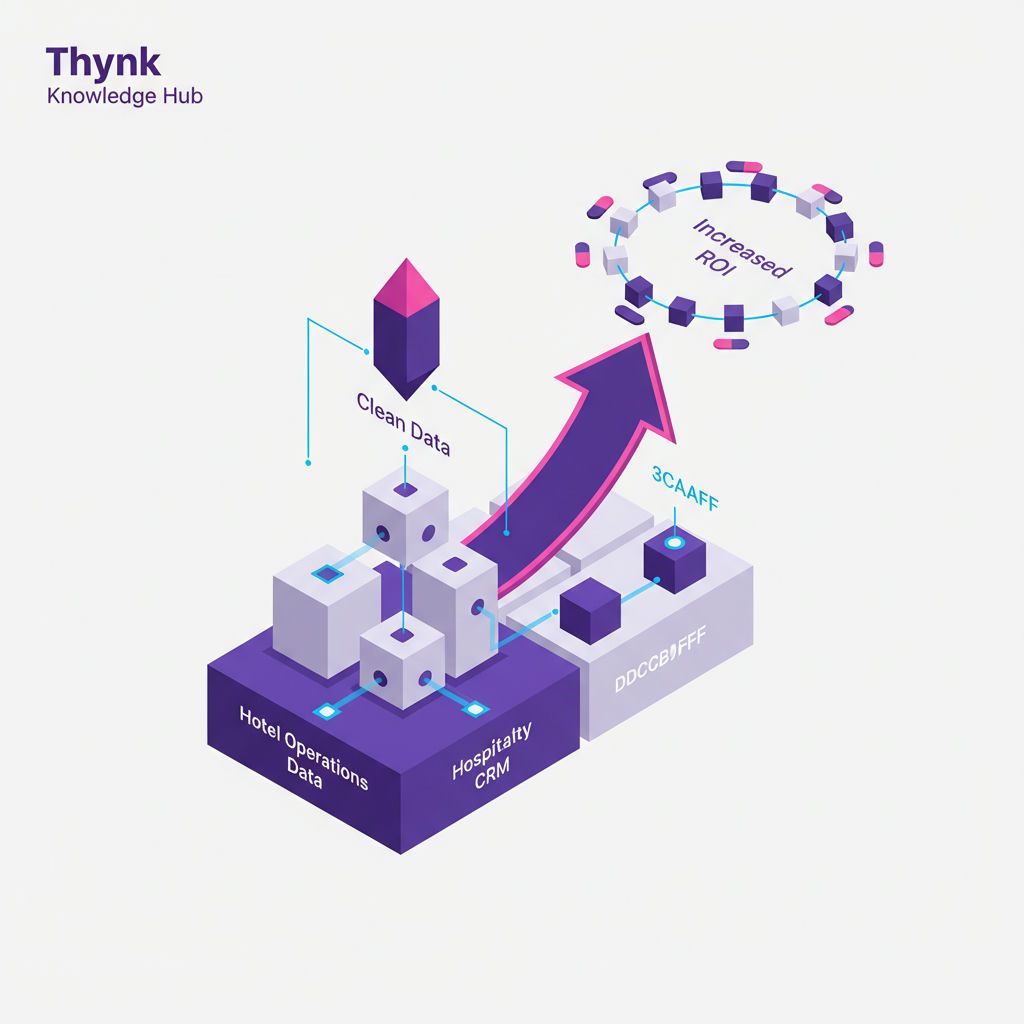
Clean Data: The New ROI in Hotel Operations
Clean data determines whether hotel operations become more efficient or just more complicated. Properties using a hospitality CRM with robust data infrastructure achieve 40-60% reductions in financial close time, 15-20% improvements in housekeeping productivity, and 30% shorter group sales cycles—outcomes impossible without single-source-of-truth architecture that ensures account hierarchy integrity, guest preference flow, and real-time system synchronisation across PMS, revenue management, and operational platforms.
Hotels achieving operational excellence in 2026 share one characteristic: they've made data quality an operational priority, not an IT concern. Properties report 40-60 hours lost monthly during financial close when data doesn't flow properly between PMS, accounting, and revenue management systems. The difference between properties that extract ROI from technology investments and those watching systems become expensive shelf-ware lies in data infrastructure discipline.
The Operational Crisis Beneath AI Hype
Whilst the hospitality industry debates AI chatbots and robotic concierges, a foundational crisis undermines every technology investment: hotel operations run on fragmented, inconsistent, poorly integrated data that exhausts operational teams and prevents competitive viability.
Consider the daily reality at a 300-room full-service property. Guest preferences captured at booking don't transfer to the PMS. Room maintenance requests logged by housekeeping don't update availability for revenue management. Dietary requirements noted by F&B don't appear in the spa booking system. VIP status in loyalty programmes doesn't trigger protocol adjustments at the front desk.
Each gap requires manual intervention. Each workaround consumes staff time. Each data inconsistency creates guest experience failures that no amount of AI sophistication can remedy.
Controllers work weekends reconciling revenue across systems. Front desk supervisors toggle between three screens to piece together guest preference history. Housekeeping managers update room status in one system whilst maintenance requests languish in another. This operational reality explains why hospitality CRM alternatives that prioritise data infrastructure over feature proliferation deliver measurable ROI whilst point solutions create integration debt that compounds over time.
Why Operations Teams Abandon Technology Investments
The pattern repeats across properties: a new system gets implemented with grand promises, initial adoption is strong, then within six months staff revert to manual processes and spreadsheets. Within twelve months, the technology becomes expensive shelf-ware. The failure isn't the technology—it's the data infrastructure beneath it.
Revenue management systems using quality data achieve measurable payback in 6-12 months through direct revenue impact. Guest experience platforms deliver ROI in 18-30 months when data quality enables genuine personalisation. But when duplicate guest records proliferate, when room type descriptions vary across channels, when integration errors require daily manual fixes, even the most sophisticated systems fail.
Operations teams abandon technology not because they resist innovation, but because poorly integrated systems create more work than they eliminate. A front desk agent juggling three screens to check in a guest isn't technology-averse—they're responding rationally to systems that don't communicate. Understanding what is a CRM system reveals why data architecture matters: hospitality CRM platforms built on enterprise foundations deliver single-source-of-truth integrity that point solutions cannot replicate through API stitching.
What Poor Data Quality Costs Your Operation
Housekeeping Efficiency Loss
When room status updates don't flow automatically between housekeeping management, PMS, and maintenance systems, supervisors spend 45-60 minutes per shift manually updating across platforms. At a 200-room property, that's 250+ hours annually—the equivalent of a full-time position lost to data reconciliation.
Properties using integrated hospitality CRM platforms with verified PMS parity eliminate this reconciliation burden entirely. Housekeeping status updates trigger automatically across revenue management, front desk availability, and maintenance workflows—creating operational velocity that compounds across departments.
Guest Service Recovery Burden
Front desk teams lacking integrated guest history face every interaction blind. A returning guest annoyed that their room preference wasn't honoured, a loyalty member frustrated their status wasn't recognised, a corporate booker whose negotiated rate didn't apply—each failure stems from fragmented data, and each requires time-consuming recovery that could have been prevented.
Best-in-class hospitality CRM implementations deliver complete guest history at every touchpoint. Preference data captured during group RFP flows to individual reservation profiles. Loyalty status updates trigger across PMS and operational systems. Negotiated corporate rates apply automatically without manual intervention.
Revenue Optimisation Blindness
Revenue managers making pricing decisions on data that takes 48 hours to reconcile across channels aren't managing revenue—they're guessing. When occupancy forecasts don't reflect real-time group modifications, when rate parity monitoring requires manual channel checks, when competitive set analysis relies on stale data, revenue optimisation becomes revenue aspiration.
Properties leveraging PACE reporting in hotel revenue management with clean data infrastructure make pricing decisions with confidence. Real-time group booking pace, accurate pickup tracking, and channel performance analytics enable dynamic pricing strategies that maximise revenue per available room without relying on stale spreadsheets or manual reconciliation.
Labour Deployment Inefficiency
Without integrated systems showing real-time occupancy, arrival patterns, and service requests, department heads over-staff to manage uncertainty. Clean data flowing between reservations, housekeeping, F&B, and engineering enables precision scheduling that can reduce labour costs by 3-5% whilst improving service delivery.
What Best-in-Class Operators Do Differently
Properties achieving operational excellence embed data stewardship in daily operations. Front desk agents understand that creating duplicate guest profiles degrades everyone's ability to deliver personalised service. Housekeepers know that accurate room status updates enable better revenue management. Revenue managers recognise that maintaining consistent rate codes across channels prevents pricing errors and guest complaints.
These aren't IT disciplines—they're operational standards enforced through training, accountability, and systems designed to make correct data entry easier than workarounds. Best-in-class properties also recognise that data quality enables the shift toward ecosystem thinking. Rather than optimising each channel or department independently, they focus on clean integrations, aligned content, and clear ownership of data standards across the operation.
This approach mirrors how hospitality operations management platforms with Salesforce-native architecture deliver account hierarchy roll-up that maintains data integrity from corporate parent through individual property to guest reservation. The results are measurable: front desk check-in times reduced by 40% when guest data flows seamlessly, housekeeping productivity improved by 15-20% when room status updates trigger automatically, guest satisfaction scores elevated when personalisation relies on complete, accurate preference data.
The AI Reality: Garbage In, Garbage Out
Every AI limitation, every failure, every instance of AI making things worse instead of better traces back to data quality.
AI-powered dynamic pricing generates nonsensical rates when historical demand data contains gaps. Automated guest messaging sends irrelevant communications when preference data is incomplete. Predictive maintenance schedules become unreliable when equipment service records aren't maintained consistently. Workforce optimisation tools produce unworkable schedules when shift patterns, skill matrices, and labour rules aren't accurately captured.
The industry's obsession with deploying AI whilst ignoring data infrastructure is building operational failures. Training housekeeping supervisors to use AI-powered task management achieves nothing if room assignments, cleaning status, and maintenance priorities don't integrate properly. Teaching revenue managers to leverage AI forecasting delivers no value if the underlying booking pace data is fragmented across systems.
Operations teams can't leverage AI effectively when they don't trust the underlying data. A front desk manager won't follow AI-generated staffing recommendations if previous suggestions were based on incomplete arrival forecasts. Housekeeping supervisors won't rely on AI-optimised room assignments if the system regularly assigns occupied rooms for cleaning. Properties exploring AI agents in hospitality must first establish data infrastructure that enables governed AI—ensuring AI operates on verified, complete information whilst preventing hallucinations and maintaining data privacy.
Building Data Literacy in Operations Teams
The critical skill gap isn't teaching staff to use AI tools—it's developing the data stewardship discipline that makes those tools effective. Operations leaders need teams who understand why consistent naming conventions matter, how data flows between systems, and when manual overrides corrupt downstream processes.
Consider housekeeping: supervisors who understand that marking a room "inspected" in their tablet triggers availability updates in revenue management, rate adjustments in the booking engine, and front desk notifications create operational velocity. Supervisors who see their tablet as disconnected from broader operations create bottlenecks.
The same principle applies across departments. F&B managers who maintain accurate menu data enable AI agents to answer dietary questions correctly. Engineering teams who log maintenance completions consistently allow predictive systems to forecast failures accurately. Revenue managers who ensure rate code integrity across channels prevent pricing errors that damage guest trust and brand reputation.
How to Fix Data Quality Before Deploying AI
Hotel operations leaders facing pressure to "do something with AI" whilst managing fragmented systems need a pragmatic execution framework.
Audit Before Automation
Before implementing any new technology, audit current system integrations and data quality. Identify where manual reconciliation happens, where data inconsistencies cause operational delays, where integration errors frustrate staff. These pain points are your priority targets, not the latest AI vendor pitch.
Map data flows across your technology stack: PMS to accounting, reservations to housekeeping, loyalty systems to front desk, Group CRS to F&B forecasting. Document every manual handoff, every spreadsheet workaround, every instance where staff toggle between screens to piece together complete information.
Fix Foundations Before Features
Invest in data infrastructure that enables systems to communicate reliably. Clean up duplicate guest records. Standardise room type descriptions. Verify that maintenance requests flow automatically to engineering. Ensure that guest preferences captured anywhere in the operation appear everywhere they're needed.
Properties evaluating hotel CRM software alternatives should prioritise platforms with native PMS integrations (not API middleware) and single-source-of-truth architecture. Salesforce-native hospitality CRM platforms deliver data integrity that point solutions cannot replicate through integration layers.
Measure Data Quality Like Occupancy
Track operational metrics that reveal data health—duplicate guest records, incomplete preference profiles, integration error rates, time-to-reconciliation during financial close, manual data entry volume. These leading indicators predict whether technology investments will succeed.
Establish data quality dashboards that operations teams review daily: guest profile completeness rates, PMS synchronisation accuracy, rate code consistency across channels, room status discrepancy frequency. When data quality metrics receive the same operational attention as occupancy and RevPAR, technology investments deliver ROI.
Build Stewardship Into Job Design
Make data quality everyone's responsibility with clear accountability. Front desk training includes profile management standards. Housekeeping procedures specify status update protocols. Revenue management processes define rate code governance. When data stewardship is "someone else's job," it becomes nobody's job.
Best-in-class hospitality CRM implementations embed data quality checkpoints in operational workflows: AI-powered duplicate detection prevents profile proliferation, automated validation rules enforce consistency, real-time synchronisation monitoring alerts operations teams to integration issues before they cascade.
Pilot With Verified Foundations
Only implement new AI-powered tools after underlying data quality is verified. Start with narrow use cases where success is measurable—automated pre-arrival messaging for guests with complete preference profiles, dynamic pricing for rate codes with clean historical data, predictive scheduling for departments with accurate shift records.
Properties using Agentforce for hospitality achieve measurable ROI because AI operates on clean data infrastructure. RFP email parsing creates accurate Opportunities because account hierarchies are verified. AI-generated proposals reflect real-time inventory because PMS synchronisation is continuous. Automated guest communications personalise correctly because preference data flows consistently.
The Thynk Approach: Data Infrastructure That Enables AI
Thynk is the Salesforce-native hospitality CRM built on the principle that clean data infrastructure precedes operational AI. As a Salesforce-native platform, Thynk provides single-source-of-truth architecture with account hierarchy roll-up, governed AI through Einstein Trust Layer and Agentforce, and verified PMS parity with leading property management systems.
Thynk's AI email parsing transforms unstructured RFP emails into structured Opportunities—but only because the underlying data model for accounts, properties, room types, and rate codes is clean, consistent, and integrated. Agentforce agents can triage, qualify, and draft proposals because Thynk's data architecture ensures AI operates on verified, complete information.
Properties using Thynk report measurable operational efficiency:
- Front desk check-in times reduced by 40% when guest data flows seamlessly from CRM to PMS
- Group sales cycles shortened by 30% when multi-property proposals generate from clean, integrated inventory
- Revenue managers make pricing decisions with confidence because PACE reporting reflects real-time, reconciled data across channels
This isn't AI magic—it's data infrastructure discipline that enables AI to deliver operational value. Thynk's Salesforce-native architecture means account hierarchies, contact relationships, and booking histories maintain integrity across the platform—eliminating the data fragmentation that undermines competitive technology investments. The platform's capability stack includes B2B CRM, Group CRS, GSO (Group Sales Optimisation), e-proposal and e-BEO generation, room-block management, and space management—all operating on unified data foundations.
Learn more about how Thynk compares to traditional hospitality CRM alternatives and why Salesforce-native architecture delivers data quality advantages impossible through point solutions or middleware integrations.
The Choice for Operations Leaders in 2026
2026 isn't the year to deploy every AI tool vendors pitch. It's the year to audit your data infrastructure ruthlessly, fix foundational integration issues, build operational discipline around data stewardship, and only then pilot technology on verified foundations.
Properties that prioritise clean data over technology novelty will establish operational advantages that compound over time. Those that chase AI trends whilst tolerating fragmented systems will watch competitors pull ahead whilst their own teams grow increasingly frustrated with technology that creates more problems than it solves.
Clean data isn't a technical prerequisite for operational technology adoption—it's the foundational advantage that determines whether your operation becomes more efficient or just more complicated. The choice is straightforward: fix your data infrastructure first, or watch technology investments fail whilst operations teams revert to spreadsheets and manual workarounds.
Operations leaders who choose execution over aspiration will build the foundation for sustainable competitive advantage through the three pillars: Salesforce performance (leveraging enterprise architecture for hospitality workflows), clean data (single-source-of-truth integrity across all touchpoints), and sales automation (AI-powered efficiency in group sales cycles). Those who choose vendor presentations over operational reality will fund expensive failures whilst properties with disciplined hospitality CRM implementations capture group revenue, expand account relationships, and accelerate sales velocity through data infrastructure that actually works.
Properties ready to establish data quality discipline should explore how to implement hospitality CRM effectively and why Salesforce-native architecture delivers the single-source-of-truth foundation that enables AI, optimises operations, and compounds competitive advantage over time.